
E-mail configuration
If two-factor authentication is enabled, you must use an app password to set up external programmes (e.g. calendar/address book apps, WebDAV clients, Drive synchronisation or Exchange ActiveSync).
Further information: Application-specific passwords for external applications
We have configured our servers so that modern email clients can automatically detect the necessary settings using your login details (email address and password). This means that, as a rule, you should not need to make any manual adjustments to set up your email account. However, if you wish to set up your mailbox manually, or indeed have to do so, please use the following settings.
How to set up your account manually
1. Email address & password for authentication
You must always log in using the following credentials:
| Username | Password |
|---|---|
| Your main email address | Your mailbox password |
e.g.: max.mustermann@mailbox.org | Your mailbox password |
2. Incoming mail server, ports and encryption
| Protocol | Server | Port | Connection security | Authentication method |
|---|---|---|---|---|
| IMAP | imap.mailbox.org | 993 | SSL/TLS | Your mailbox password |
| POP3 | pop3.mailbox.org | 995 | SSL/TLS | Your mailbox password |
3. Outgoing mail server, ports and encryption
| Protocol | Server | Port | Connection security | Authentication method |
|---|---|---|---|---|
| SMTP | smtp.mailbox.org | 465 | SSL/TLS | Your mailbox password |
| SMTP (alternative) | smtp.mailbox.org | 587 | STARTTLS | Your mailbox password |
Connecting external accounts
In our mailbox Office, you can connect email accounts from other providers such as GMX, web.de or mail.de. Google has blocked access via mailbox Office since the end of April 2022. Move away from Gmail to mailbox – step-by-step
Integrating external accounts offers several advantages:
- You can read emails from the integrated accounts in the web client.
- You can send emails using the sender address of the integrated account directly from the web client.
- This allows you to consolidate all your email accounts and manage them centrally via the mailbox web client.
- With the Unified Mail feature, you can even have a shared folder for multiple email accounts – e.g. all emails in a shared Inbox and Sent Items.
Settings with the external provider
With some providers, it is necessary to configure settings to enable integration – for example, the provider must allow the IMAP or POP3 protocols and SMTP (for sending emails).
Please consult your provider’s documentation or support team for further details.
You can integrate external mailboxes in three different ways:
1. mailbox as an email client (IMAP)
mailbox Office acts as an email client and displays messages from the external provider separately – in an additional, separate mailbox below your mailbox inbox.
When composing a new email, the email address(es) of the external mailbox are displayed in the ‘From’ field for you to select. By default, sent messages and the inbox are only displayed in this mailbox, not in the mailbox inbox.
This allows you to integrate both external and mailbox inboxes that are intended to be used by several people at the same time. Business customers can conveniently integrate so-called family accounts here.
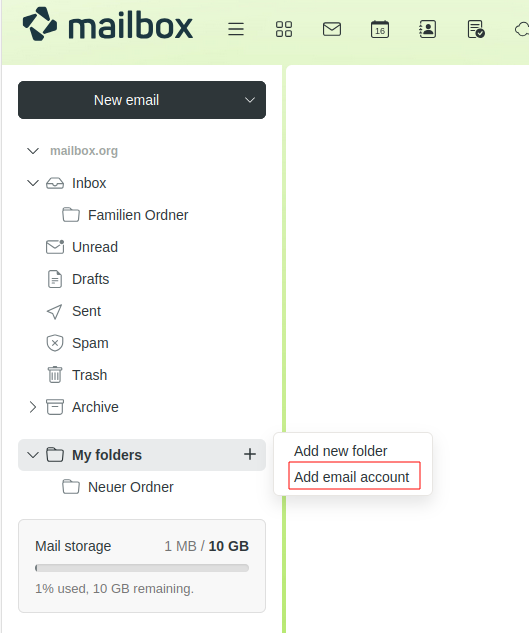
Adding an external email account via the email inbox
Alternatively, you can add your external email account in the settings: All settings > Accounts > Your accounts > Add email account
You can cancel a mail retrieval request created in this way by clicking the X.
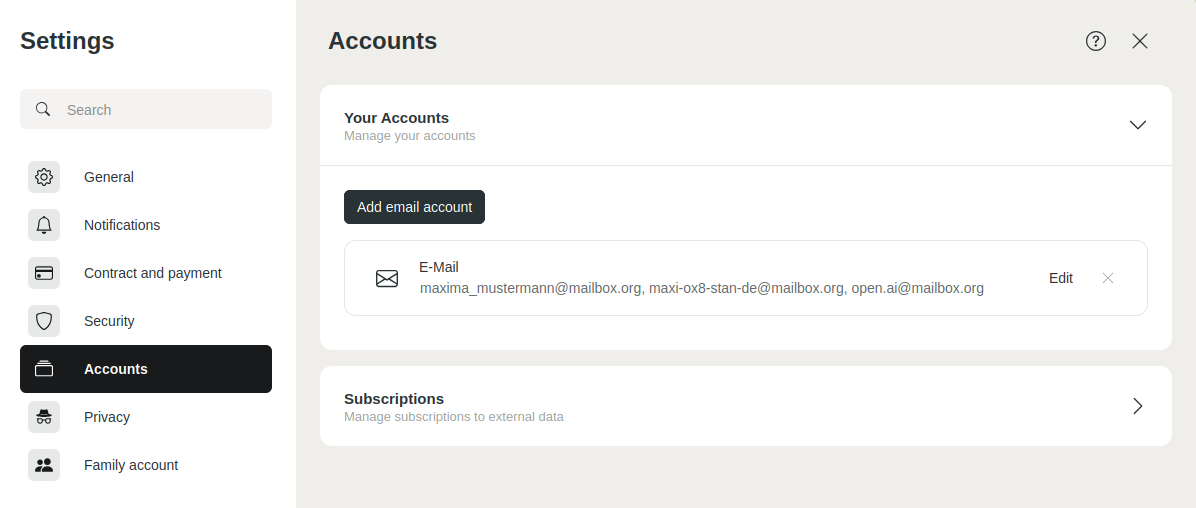
Adding an external email account via the mailbox settings
2. mailbox as a POP3 client
If you use the POP3 protocol to retrieve emails from your external provider, all emails are downloaded and then deleted – at least by default. The messages will then only remain in your mailbox inbox.
Sending emails using the external mailbox’s email address is not possible in this way.
Retrieval interval:
mailbox retrieves emails from external POP3 accounts every 30 minutes. In exceptional cases – for example, when there is a high volume of emails – the intervals may be longer.
All emails that arrive in your mailbox inbox in this way can be used with all of mailbox’s features – these include:
- Server-side filter rules using Sieve
→ Can I use Sieve mail filtering? - Inbox encryption
→ Your encrypted mailbox
If you prefer to retrieve your emails via IMAP or set up a direct connection using forwarding or aliases, please also see:
To set up an external POP3 account in mailbox, proceed as follows:
- Open All settings.
- Navigate to External POP3 accounts.
- Enter the external account in the Email Address field.
- Click the Determine server settings button.
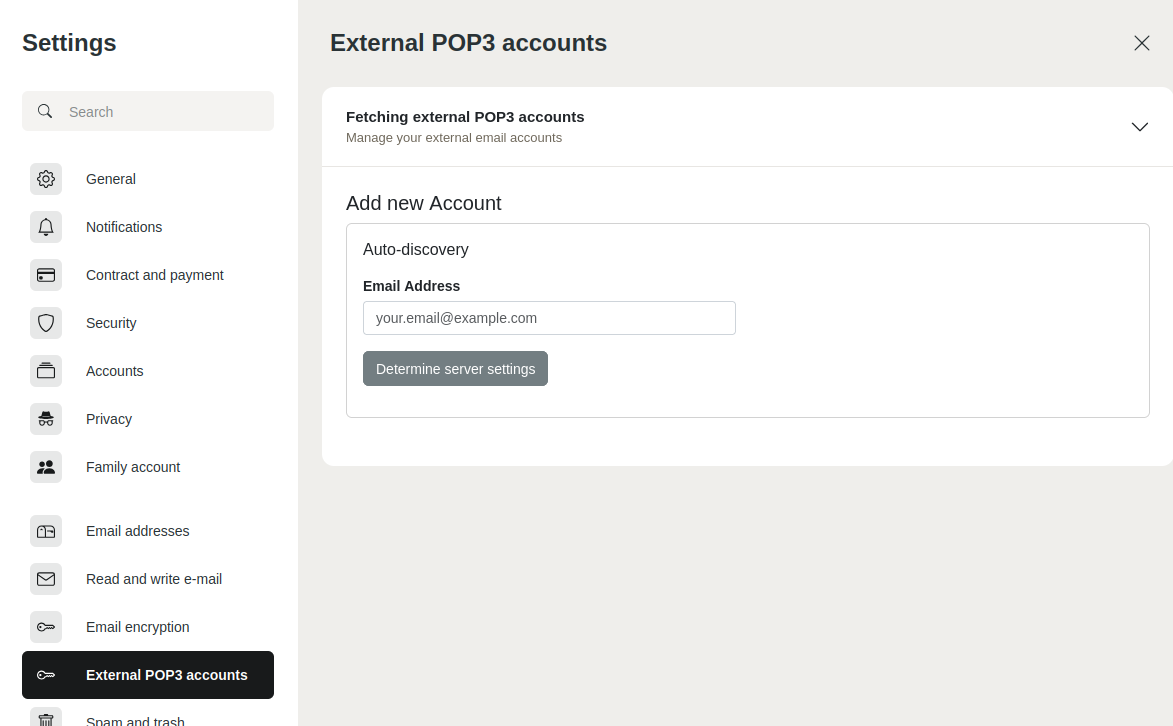
Adding an external email account using POP3
Your login details are stored securely in encrypted form. Please ensure you enter the correct server details (hostname, port, encryption type) – you can obtain these from your external email provider.
The POP3 protocol can only download emails from the inbox, as it does not support the concept of email subfolders. Other email folders in the mailbox (apart from the inbox) are not retrieved or synchronised by the POP3 protocol – if you require this, you must use IMAP.
3. Full integration
If you integrate an external mailbox via IMAP and SMTP, you can also select the address of the external mailbox in the From field when composing a new email.
During the initial setup, mailbox sends a confirmation email to the external mailbox. By clicking on the link contained within, you confirm ownership of this address. Only then will sending via mailbox’s SMTP servers with this sender address be permitted – this process is known as mail relay.
With this method, it is not possible to receive emails via this external address in your mailbox inbox. Messages sent using this sender address will appear exclusively in the Sent Items folder in mailbox.
This option is not recommended if you regularly communicate with professional email providers or corporate addresses. Many receiving systems require SPF or DKIM checks, which cannot always be verified correctly with Mail Relay.
How to set up the external sender address
- Open All Settings.
- Navigate to Email addresses > Alternative senders.
- Enter the desired external email address.
- Click Send activation link to verify the address.
An activation link will now be sent to the address provided. For security reasons, this link has a time limit and must be used within 15 minutes – otherwise it will expire. Open the link so that you can then use your external email address as the sender in mailbox.
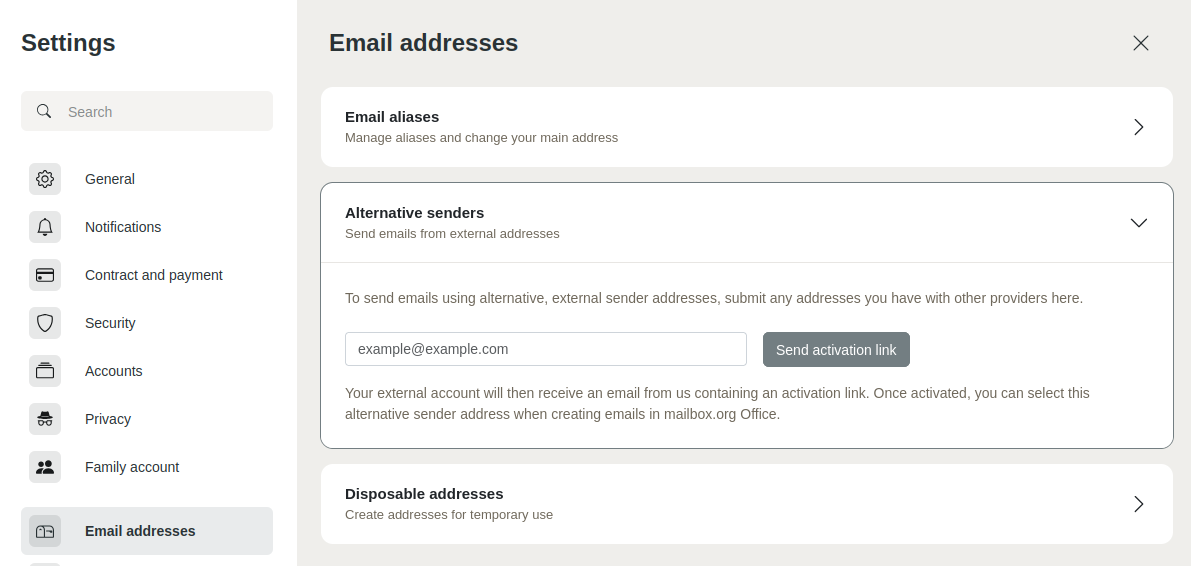
Adding an external email account using IMAP and SMTP
Problems with SPF spam protection
If a very restrictive SPF record is set for the sending domain, this may cause delivery issues for emails sent in this way. Please refer to the articles in the category Using email addresses with your own domain.
Remove alternative senders
In the mailbox settings > Email addresses > Alternative senders, you can not only add new sender addresses but also remove existing entries.
To delete an alternative sender:
- Open All settings.
- Go to Email addresses > Alternative Senders.
- Select the entry for the relevant external address.
- Click Delete.
Messages that have already been sent remain in the Sent Items folder and are not affected.
Restrictions with Mail Relay
When sending via Mail Relay (i.e. using the address of an external mailbox via the mailbox servers), problems can regularly occur:
- Many receiving mail servers now check whether the sender domain matches the sending infrastructure.
- If the domain and the sending server do not match, SPF and DKIM checks will fail.
- The result: your emails will be rejected or placed in the spam folder.
As more and more major email providers (e.g. Gmail, Microsoft, Yahoo) are adopting these authentication methods, using Mail Relay may result in delivery issues.
This method should only be used in exceptional cases – for example, for occasional sending via an external address over which you have no full technical control (e.g. DNS entries).
Unified Mail – a universal inbox
If you have linked multiple email accounts to mailbox (e.g. via IMAP), the folder list can quickly become confusing. With the Unified Mail feature, mailbox offers a convenient solution: a central inbox, which clearly combines incoming and sent emails from all linked accounts.
Enabling Unified Mail:
- Open All Settings via the cog icon.
- Navigate to Accounts.
- Click Edit for the desired linked account.
- Tick the box next to Use unified mail for this account – including for the mailbox account itself.
- Under Standard folders, select which folders should be used for Sent and the Trash.
- Click Save.
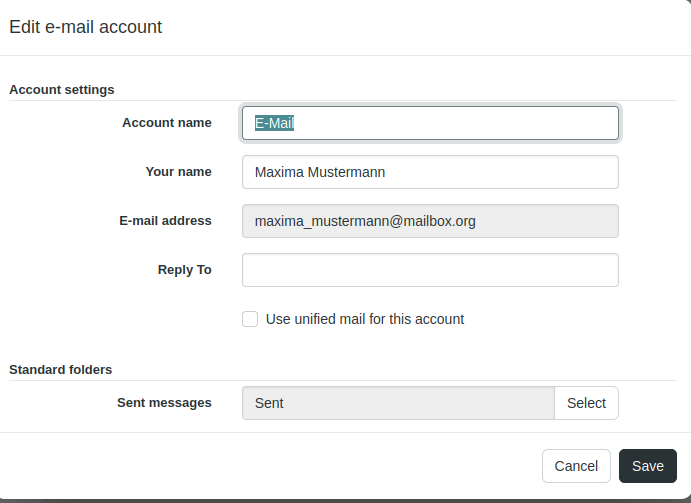
Setting up a central inbox as Unified Mail
Unified Mail displays content in a consolidated view without altering the structure of individual accounts. You can still access all the original folders for each account.
With Unified Mail, you get a centralised overview of all inboxes and sent messages without having to constantly switch between accounts.
Error message: Sender address rejected: not owned by user
To prevent address spoofing and misuse, mailbox only allows messages to be sent using sender addresses registered in your account – i.e.:
- your primary email address,
- aliases set up under All settings > Email addresses > Email aliases.
Particularly in a professional context, it may be necessary to use different sender addresses, for example:
- for the internal allocation of specific processes,
- for emails sent automatically from IT systems.
In such cases, you can use your own domain and, by configuring a catch-all alias (collective address), ensure that replies are delivered to any address within your domain.
This requires that the domain is correctly integrated into your mailbox account and that the DNS configuration is set up accordingly. You can find details on this in the article: Using e-mails with a custom domain.
Our servers reject outgoing emails from senders that we cannot associate with your account or who do not have an account with mailbox, displaying the following error message:
553 5.7.1 wrongaddresse@example.com: Sender address rejected: not owned by user realuser@example.com
Primary addresses, aliases, mail extensions, alternative senders and disposable addresses are not affected by these restrictions.


